전시
-
 2026 아르코미술관 주제기획전 《예술 학교: 우리가 서로의 학교가 될 때,》
- 전시기간
- 2026.08.07~2026.09.27
- 관람료
- 무료
- 오프닝
- 8월 6일(목) 17:00
- 장소
- 아르코미술관 제1, 2전시실
- 작가
- 머터리얼 라이브러리, 모크캠프, 버드콜, 쿠로다, 큐레이팅 스쿨 서울, 행복반, PIE, YPC × 학회쥐
- 부대행사
- 워크숍, 리딩클럽, 집담회 등 전시 연계 프로그램 20회
- 주관
- 아르코미술관
- 주최
- 한국문화예술위원회
- 문의
- 02-760-4607
- 담당부서
- 미술관운영팀
- 담당자
- 노해나
첨부파일
2026 아르코미술관 주제기획전 《예술 학교: 우리가 서로의 학교가 될 때,》
▣ 전시개요
- 전시명 : 2026 아르코미술관 주제기획전 《예술 학교: 우리가 서로의 학교가 될 때,》
- 참여작가 : 머터리얼 라이브러리, 모크캠프, 버드콜, 쿠로다, 큐레이팅 스쿨 서울, 행복반, PIE, YPC × 학회쥐
- 기간 : 2026.8.7.(금) - 9.27.(일)
- 운영시간 : 화-일요일, 11시-19시 (매주 월요일 휴관, 매주 수요일 21시까지 연장 운영)
- 장소 : 아르코미술관 제1, 2전시실
- 관람료 : 무료
- 주최 : 한국문화예술위원회
- 후원 : MnJ문화복지재단, 서전문화재단법인
▣ 전시소개
《예술 학교: 우리가 서로의 학교가 될 때,》(이하 《예술 학교》)❶는 창작자 스스로 필요한 교육 과정, 모임, 워크숍 등을 자립적으로 조직하는 동인, 콜렉티브, 스튜디오, 미술공간, 학교가 참여한다.❷ 전시는 공동의 관심사를 중심으로 창작과 활동을 지속하기 위해 모인 자기조직화 주체들의 동력과 태도를 살펴보며,❹ 협업과 공동창작, 지식 나누기, 동료 만들기를 통한 배움의 실천에 대해 말한다. 나아가 결과로서의 전시보다 질문을 발생시키고, 그 과정에서 창작이 일어나며 동료가 만들어지는 과정 그 자체의 현장이 되고자 한다.❸ 전시 기간 동안 작가, 동료, 관객이 함께 만날 수 있는 소규모 모임과 다양한 프로그램이 열리며, 연습, 실험, 리서치 등 작업의 단계를 노출하기도 한다.❺ 이 모든 것은 책상에 앉아 동료들이 나누는 대화와 웃음, 격려와 지지를 재료 삼아 만들어진다.❻
예술 학교 위키 artartart.wiki
- ❶ 예술 학교의 ‘학교’는제도적 교육기관이나 정규 교육 과정이라는 의미에서 벗어나 다시 정의된다. 예술 학교는 제도의 바깥에서 자생적으로 예술 실천을 이어가는 예술가와 집단적 주체, 그 활동이 만들어 나가는 연결과 관계에 관한 이야기이다.
- - 아르코미술관이 운영했던 인사미술공간(이하 인미공, 2000–2025)은 신진작가 양성과 교육적 기능을 수행해 왔다. 예술 학교는 전시보다 ‘창작이 가능했던’ 인미공의 역할을 되새기며, 예술가들의 창작과 지식의 잠재적 기능을 하는 스튜디오, 실험실, 사랑방이 되고자 한다.
- ❷ 예술 학교에는 8팀, 총 42명의 예술인이 참여한다. 참여 작가는 동인, 콜렉티브, 스튜디오, 미술공간, 학교 등 다양한 이름으로 불린다. 이들은 스스로 조직을 이루고 자체적으로 기관과 제도로 기능하는 구조를 만들어 간다. 워크숍, 강연, 모임을 독립적으로 기획하고, 동료들과 필요한 지식을 나누고 함께 공부하며 배움을 찾아간다. 이러한 활동은 전시라는 문법을 선택하기보다 이를 둘러싼 환경과 사람들의 관계망, 인적 네트워크를 조직하는 것으로 이어진다.
- ❸ 미술 현장의 동료는 서로에게 학교가 된다. 이들은 공동의 관심사를 공유하고, 창작의 고독 속에서도 계속해서 나아가게 하는 힘을 준다. 또한 동료들이 함께 배움의 과정을 조직하는 가운데 구성원 각자는 실무를 직접 수행하며 그 과정을 경험한다. 그 동료들은 리뷰와 의견 교환을 통해 지식의 새로운 경로를 탐색한다.
- ❹ 한편, 자기조직화는 불확실한 시대를 살아가는 예술인들의 삶의 방식이자 대안적인 선택이기도 하다. 교육 제도나 국가가 제 역할을 다하지 못할 때, 스스로 해결책을 모색하며 자신의 자리를 만들어가는 것이다. 이러한 자립과 독립의 현상은 신자유주의 시대의 청년들이 변동에 적응하고 위기를 관리하는 방식과 맞닿아 있으며, 문제의 책임과 해결을 개인의 몫으로 돌리는 현실을 드러낸다. 여건이 나아질 것이라는 보장이 없는 상황에서 자립이 강화되는 움직임은 청년 예술가들의 분투를 보여준다.
- ❺ 미술관은 일시적으로 학교라는 복합체를 가동한다. 학교라는 테두리는 연습과 실패, 배움의 과정을 품는다. 동시에 학교는 미술 현장이 어떤 조건 위에서 작동하는지, 예술인들은 서로 어떻게 연결되는지, 그리고 제도 안팎의 생태계가 어떻게 형성되는지, 그 환경을 드러낸다.
- ❻ 그렇다면 예술 학교는 무엇이 되어야 할까? 공동의 관심사를 바탕으로 형성되는 정서적 유대, 개방과 공유를 통한 지식의 확장, 스승과 선배, 후배, 동료들 간의 관심과 애정 어린 지켜봄, 그리고…
서로 응원하고 가끔 갈등하고 이를 지혜롭게 해결하고 결국 연대하는, 척박한 창작의 날들에 동료가 되어주는 과정
ㅡ 행복반(고경호)
자기만의 방식으로 세계를 상상하기. 그리고 타인이 상상하는 세계는 무엇일지 궁금해하기. 그렇게 서로의 세계를 나누고 함께 몰입하기
ㅡ 쿠로다
서로의 미완을 곁에 두고 아직 보이지 않는 장면을 함께 밝혀가는 과정이다.
ㅡ 모크캠프(박주연)
스스로의 존재 가치와 창작을 지속해야 하는 동력과 동기를 공유하고 연대하는 곳 혹은 모임
ㅡ 머터리얼 라이브러리
우리는 서로를 끝내 다 옮기지 못한 채 헤어지고, 그러는 사이 계속해서 판본이 늘어난다.
ㅡ 큐레이팅 스쿨 서울 · 서울리딩룸(박재용)
예술 학교는 오후의 저물어가는 햇살이 비스듬히 내려앉은 한 호프집, 불가해한 폭력으로 얼룩진 유년 시절, 미술학원을 밝히는 형광등 불빛, 비건 친구를 위해 고기 빼고 주문한 마라샹궈, 금융위기와 파업, 무엇이든 될 수 있었기에 아무것도 될 수 없었던 무수한 가능성들, 가르치지 않아도 알았던 사실들, 그리고 그 모든 것들을 결코 되돌려주지 않으면서 받고, 고맙다고 말하지 않는 곳입니다.
ㅡ 학회쥐
그럼에도 불구하고 우리가 연결을 원하는 까닭은?
ㅡ PIE
*더 많은 답변은 〈아트아트아트.위키〉를 확인하세요.
▣ 작품 소개
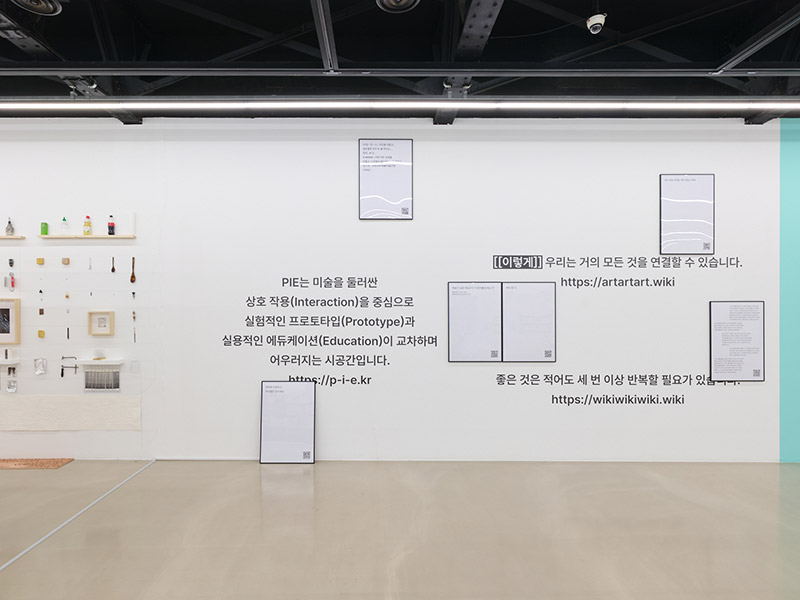
PIE, 〈PIE는 아무래도 당신을 사랑합니다. 당신은 아무래도 PIE를 사랑합니다.〉, 잉크젯 프린트, 액자, 91×61cm (30)
PIE(이하 파이)는 2014년에 만들어진 단체이자 공간으로, 박현정, 돈선필, 민구홍, 손주영이 운영한다. 예술 현장에서 다양한 방식으로 활동하는 예술가의 방법론이나 실험을 기반으로, 예술가를 위한 실용적 커리큘럼을 제공한다. 자기 계발을 위한 프로그램을 생산하기보다 스스로 질문을 일으키며 생각하는 힘을 기르는 커리큘럼을 지향한다.
이번 전시에서는 언어와 기록을 매개로 배움의 태도를 제안하는 프로젝트를 선보인다. 〈PIE는 아무래도 당신을 사랑합니다. 당신은 아무래도 PIE를 사랑합니다.〉는 파이의 튜터들이 작성한 배움에 관한 문장을 30개의 포스터로 제작해 전시장 곳곳에 설치한 작업이다. 배움의 근간인 말과 글을 활용해 미술을 향한 사랑 고백을 전하는 일종의 선언문이기도 하다.
〈아트아트아트.위키〉는 파이 운영자 민구홍이 개발한 텍스트 파일 기반 PHP 위키 엔진 ‘위키위키위키’(wikiwikiwiki.wiki)로 만든 디지털 공유 공간이다. 복잡한 설정 없이 텍스트를 작성하고 하이퍼링크를 생성할 수 있으며, 링크를 따라가다 보면 문서 간 관계성이 드러난다. 〈아트아트아트.위키〉는 전시, 작가, 관람객을 실시간 문서를 통해 연결하고 확장하며, 미술이 발생하는 이야기를 끊임없이 생산하는 대화의 공론장을 만들고자 한다. 위키는 전시 이후에도 계속 활성화된다. 〈잃어버린 문장을 찾아서〉는 전시장 곳곳에 흩어진 문장을 QR 코드와 웹 애플리케이션을 통해 수집하는 텍스트 기반 설치이다. 이 작업은 텍스트를 유통하고 출판하는 작은 장치로서, QR코드를 통해 읽는 행위를 걷기, 찾기, 저장하기, 잃어버리기의 행위로 이어지게 한다. 관람객은 미술관 내부에 숨어있는 QR 코드를 찾으며 ‘예술 학교’와 관련된 짧은 문장을 수집하고 이를 통해 능동적인 배움과 연결을 수행한다.
파이는 이번 전시의 참여 작가인 동시에 인적 네트워크 플랫폼이 되어 참여자들을 하이퍼링크처럼 연결한다. 그중 하나로, 전시 사전 프로그램 「러닝 위드 피어스」(Learning with Peers)를 통해 모크캠프가 미술공동체로서 지속 가능할 수 있도록 공간 운영에 도움이 되는 ‘메이트’의 역할을 수행했다. 파이는 모크캠프가 《예술 학교》에 선보일 ‘전시 설치 연습’을 위해 구성원을 모으고, 프로젝트를 구체화해 가는 단계에서 리뷰와 조언을 건넸다. 또 다른 연결로는 은행열매사교클럽을 초청한 것이다. 은행열매사교클럽은 서브컬처의 관심사를 공유하는 청년 시각 예술가들의 모임으로, 2025년 스튜디오 파이에서 무엇이든 시도해 볼 수 있도록 그들에게 공간을 내어준 것을 계기로 결성되었다. 이런 차원에서 파이는 (비제도권) 교육기관의 역할을 수행하는 것처럼 보이기도 한다. 그러나 무엇보다도 이들은 창작자들이 스스로 설 수 있는 조건과 환경을 고민하고, 미술 행위자들을 서로 연결하는 일에 그 활동의 토대를 둔다.
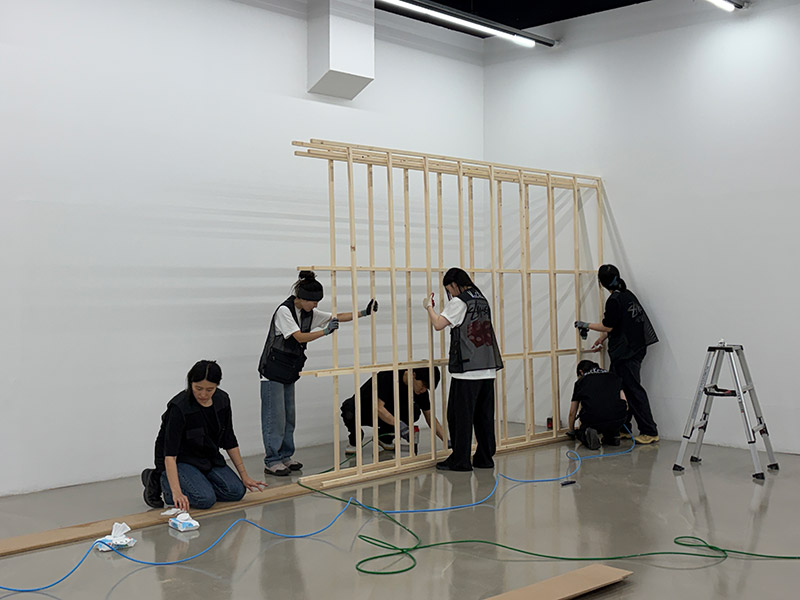
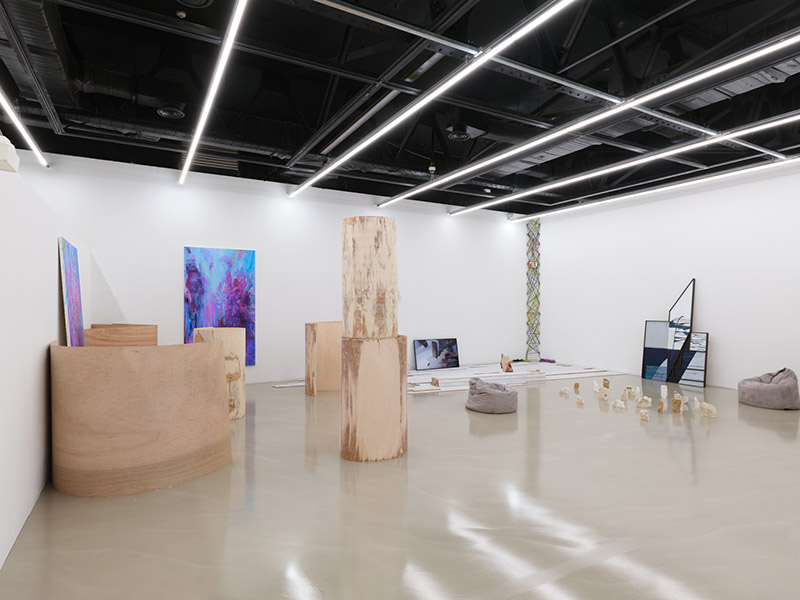
모크캠프, 〈모크캠프〉, 2026, 김나영, 김자연, 박주연, 윤여진, 이상희, 이언제, 천현령, 최지음이 제작한 창고와 가벽, 실시간 상영, 개별 작업, 8인의 활동, 1200×685×390cm. 단체설치① 전경.
모크캠프의 출발은 모크캠프 그 자체를 설명해 준다. 모크캠프의 박주연은 혜화동 전셋집의 전세금을 돌려받을 수 없는 상황이 되자, 이를 집이 아닌 모두가 점유할 수 있는 미술공간으로 전환했다. 작가는 공사 기술자에게 가벽 세우는 법, 타일 까는 법 등을 배운 다음 직접 공간을 개조해 전시 기능을 갖춘 미술공간으로 탈바꿈시켰다. 이렇게 모크캠프 혜화기지는 2025년에 문을 열었다. 작가들이 설치를 실험하고, 작업실이 없는 이들도 활용할 수 있는 공간을 만들어 보자는 취지였다. 모크캠프 혜화기지는 어떠한 평가 없이 누구나 선착순으로 무료 대관이 가능한데, 그 조건은 일주일 동안 전시 설치를 연습해야 하고, 설치를 운영할 수 있는 3인 이상의 팀을 구성해야 한다는 원칙하에서 진행된다. 또한, 하루 한 차례 설치를 진행하고, 매일 방문해 기록을 남겨야 한다. 모크캠프는 오픈소스이자 개방형 공간을 지향하며, 일주일간 공간에 모인 이들은 일시적이나마 모크캠프의 능동적 운영자가 된다. 궁극적으로 모크캠프는 동료를 만들고자 한다.
모크캠프 혜화기지에서 만나 운영진이 된 4명의 작가 김나영, 김자연, 박주연, 최지음은 이번 전시에서 공개 모집을 통해 합류한 윤여진, 이상희, 이언제, 천현령과 한 팀을 이루어 아르코미술관과 혜화기지를 오가며 그들만의 캠프를 운영한다. 모크캠프원 8명은 전시가 열리는 동안 릴레이로 4일씩 전시 설치 연습을 수행한다. 완결된 전시라는 문법을 뒤집고, 동료의 도움과 협업을 통해 설치, 전시, 철수를 반복하며 작품이 지속해서 변해가는 과정을 관객에게 공개한다. 이들은 설치를 위한 구조물을 공동 제작하고, 서로의 도움을 받아 작품을 설치하며 자신의 작품에 동료를 개입시킨다. 모크캠프 혜화기지의 상황과 캠프원 활동은 라이브 스트리밍을 통해 실시간으로 송출된다. 동료들과 함께두 달 동안 거듭하는 연습과 리허설은 실패하고 수정하는 과정 자체가 하나의 실험이 된다. 그리고 이 시간은 또 다른 창작으로 이어질지 모른다.
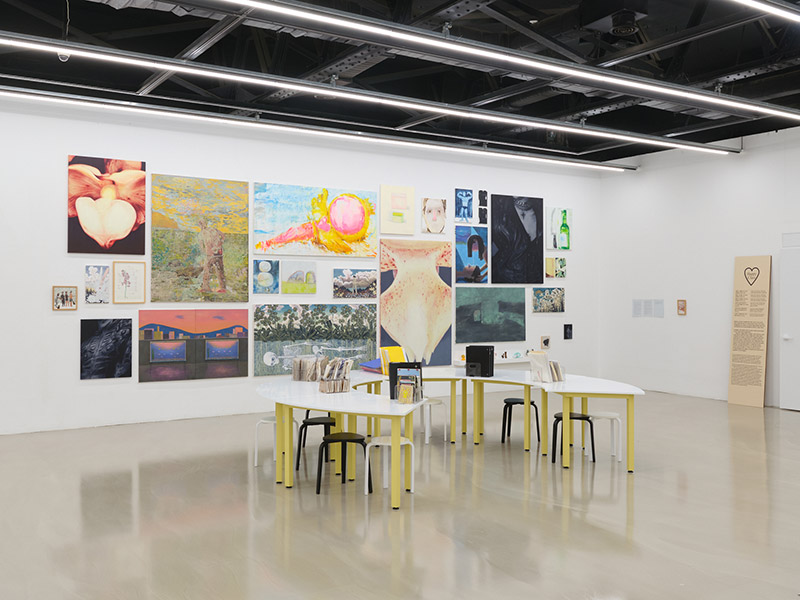
행복반, 〈그림들〉, 2014-2026, 혼합매체, 가변크기 (26)
행복반, 〈조각들〉, 2025-2026, 혼합매체, 가변크기 (8)
행복반, 〈드로잉들〉, 2023-2026, 혼합매체, 가변 크기 (76)
김지원, 〈비슷한 벽 앞에서〉, 2002, 종이에 볼펜, 과슈, 오브제, 25.5×25cm
김지원, 〈밝은 미래를 설계하는 책상〉, 2001, 종이에 펜, 과슈, 21×12.5cm
김지원, 「그냥 풀과 째즈」, 2026, 종이에 프린트, 29.7×21cm
행복반은 2023년부터 드로잉을 매개로 고경호, 김승규, 라미연, 임지현, 함성주, 황예랑 6명의 회화 작가가 결성한 모임이다. 박이소 작가의 드로잉 커리큘럼을 훈련 삼아 실천해 보자는 결심에서 출발한 행복반은 매일 드로잉을 하고 매달 모여 각자의 드로잉북을 펼쳐 보이며 작업에 대해 질문하고 응답하는 시간을 가져왔다. 이러한 만남은 서로를 평가하기보다 작업을 지켜보고 지지하며, 각자의 방식으로 작업을 지속할 수 있게 하는 동력이자 동료를 만드는 과정이 되었다.
〈드로잉들〉은 그동안 행복반이 매일 그린 작업의 기록으로, 감각과 생각을 그리기로 수행하는 일상의 실천을 보여준다. 관람객은 행복반 구성원들의 그림이 되기 전의 스케치, 생각으로서의 드로잉, 그 자체로 하나의 매체가 되는 드로잉 등이 담긴 드로잉북을 펼쳐보며 창작의 즐거움을 엿볼 수 있다. 벽면을 채운 〈그림들〉은 행복반 구성원들이 서로의 작업에 남긴 소감과 인상을 바탕으로 선정한 것이다. 동료가 작품을 선정하는 행위는 동료의 시선을 통해 자신의 작업을 다시 발견하게 한다. 이는 작업실로 돌아가 작업의 시간을 쌓아가는 것, 나아가 동료들의 응원과 지지 속에서 고독하지만 그림을 계속 그려 나가는 것의 의미를 되새기게 한다.
〈그림들〉에서는 동료에 대한 해석을 확장하고자 작가 김지원을 초대한다. 김지원은 이들에게 스승이자 선배이며, 오랫동안 작업을 지켜봐 온 동료이기도 하다. 행복반은 이번 전시를 계기로 지난 4월 김지원을 만나 작가로 살아가는 것에 대한 고민과 작업을 지속할 수 있게 하는 습관, 드로잉에 관한 이야기, 교육자로서의 교육 방식, 그리고 동료 작가와의 그림 교환에 얽힌 이야기를 들었다. 전시장에는 김지원의 회화 2점과 에세이가 행복반의 그림과 함께 놓인다. 〈밝은 미래를 설계하는 책상〉(2001)은 김지원이 미술 잡지에서 발견한 박이소의 설치 작업 도판으로부터 영감을 받아 그린 원작과 동명의 작품이다. 〈비슷한 벽 앞에서〉(2002)에서는 다양한 시대의 작가들을 한 자리에 그렸다. 「그냥 풀과 째즈」(2026)는 박이소와의 그림 교환에 대한 에피소드와 그의 소식을 적은 단상이다. 스승이자 선배 작가 김지원과 그가 기억하는 또 다른 작가 박이소는 여기 행복반 동료들의 의견이 덧붙여진 그림 공동체 안에서 우연히 마주치고 인연을 맺으며 느슨하게 연결된다.
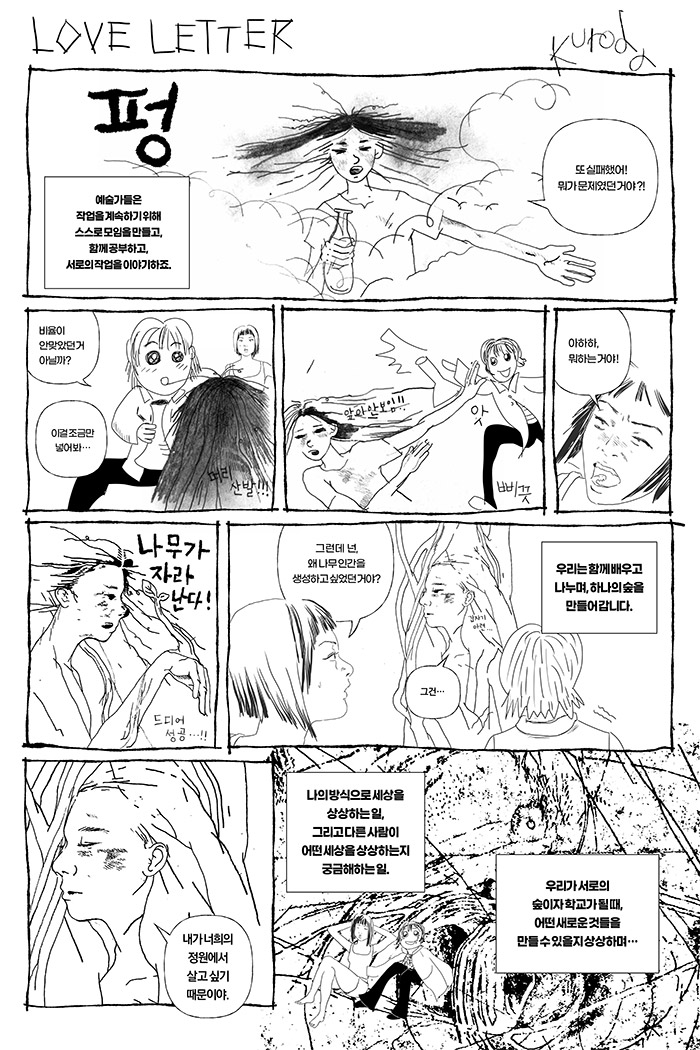
쿠로다, 〈러브레터〉, 2026, 종이에 실크스크린, 200×150cm
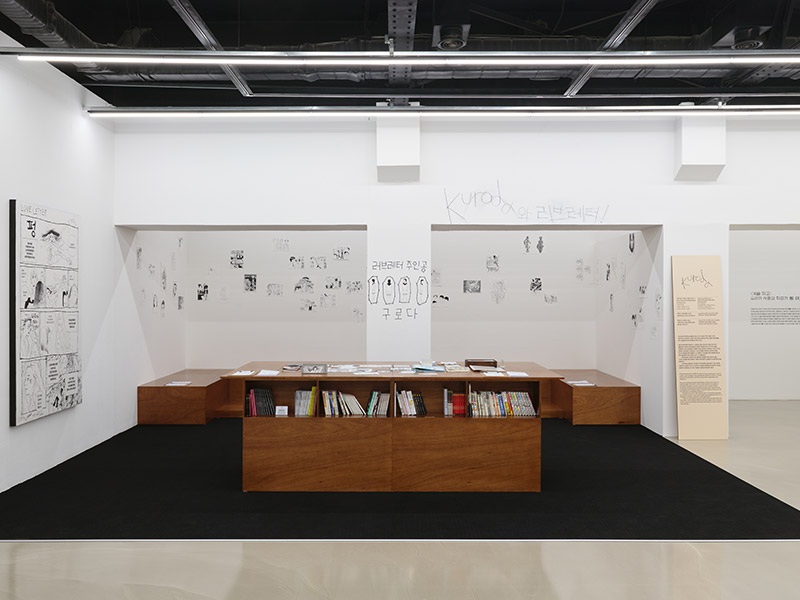
쿠로다 전시 전경
2022년 가을, 이태원의 한 카페에 모여 만화 모임을 시작한 림파, 유나, 유난은 동인 문화의 울타리 안팎에서 비평과 창작을 하며 함께 많은 것을 보고 만들기로 한다. 2023년에 본격적으로 활동한 이들은 각각 미술가, 작가, 만화가로서 만화라는 공동의 관심사를 토대로 정기적인 모임과 독립 출판, 전시 등을 통해 만화 매체를 탐구하고 있다.
쿠로다는 만화의 소재와 장르를 함께 정하고 각기 다른 스타일로 그리는 만화 워크숍, 만화를 함께 보고 대화를 기록하는 잡담회를 이어왔다. 특히 원작의 캐릭터와 세계관을 차용해 만드는 동인 문화의 방법론에 주목해, 다양한 개인이 원작을 재구성하고 새로운 창작물을 만들어내는 작화 워크숍을 조직해 왔다.
이번 전시를 위해 쿠로다는 시각예술, 영상, 음악 등 다양한 분야에서 활동하는 친구들을 모아 짧은 만화를 만드는 사전 워크숍을 진행했다. 이야기를 만들고 그림을 그리는 사전 워크숍 과정에서 쿠로다는 가상의 주인공 캐릭터 ‘구로다’를 구상하였고, 그의 친구들은 그 캐릭터의 성격과 세계관에서의 역할을 함께 설정했다. 이 과정에서 나온 짧은 토막 만화를 엮은 한 권의 앤솔로지 만화 〈있잖아 내가…〉가 출판된다. 만화라는 공통의 관심사를 바탕으로 친구와 동료들이 공동 제작하는 과정은 서브컬처 코드를 공유하는 동인 문화 특유의 정서적 유대를 엿보게 한다. 그렇다면 미술 현장에도 이러한 유대와 애정을 공유하는 집단과 문화가 존재할까? 공동 작업은 이러한 질문을 남기며 〈러브레터〉로 이어진다. 〈러브레터〉는 다양한 미술 공동체가 예술을 다루는 방식과 실천을 보여주는 작업으로, 일종의 자기조직화에 관한 만화이다.
한편, 워크숍 결과물과 빈 시트, 다양한 만화책이 비치된 〈너에게〉는 관람객이 자기만의 ‘러브레터’를 만들어볼 수 있는 참여형 작업이다. 만화의 이야기가 누군가의 마음에 들어왔던 것처럼, 이 작업은 참여자가 애정하는 또 다른 사람에게 마음을 전하도록 이끈다.
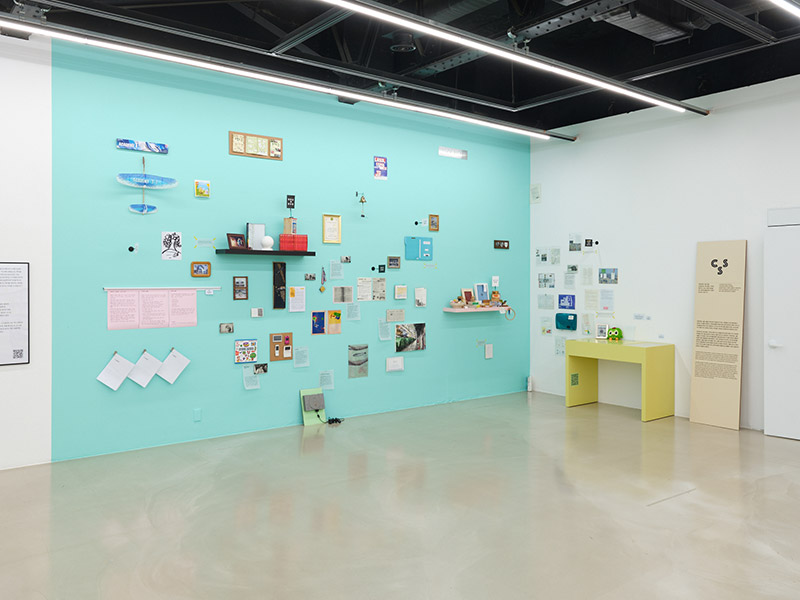
큐레이팅 스쿨 서울, 〈안팎으로, 위아래로, 거꾸로 배우기〉, 2026, 벽에 인쇄물, 전시 참여자들로부터 수집한 오브제, 가변 크기
큐레이팅 스쿨 서울은 무엇이든 ‘만들고자’ 하는 사람들이 모여 함께 묻고 배우는 자리를 마련하고, 큐레이팅을 매개로 동시대의 창작과 교육이 만나는 지점을 탐색하는 학교 실험이다. 2013년 제0학기를 운영한 이후 2023년에 다시 열었으며, 현재는 박세진, 박재용, 이은송이 공동으로 운영하고 있다. 매 학기 10여 명의 코어 멤버를 선정하는데, 그 기준은 미술 분야의 경력이나 학력이 아니라 ‘무엇을 만들고 싶은가’라는 질문이다. 학기별로 큐레이팅, 스쿨, 서울을 열쇠 말로 워크숍과 세미나, 공개 강연, 현장 방문, 실습을 진행한다.
〈안팎으로, 위아래로, 거꾸로 배우기〉는 《예술 학교》 참여 팀이 각기 어떠한 과정을 거쳐 미술 생산자가 되었는지를 따라가는 작업이다. 큐레이팅 스쿨 서울은 두 차례의 서면 인터뷰를 통해 일곱 팀에 속한 구성원 개인의 배움의 과정과 팀의 출발점에 관해 물었다. 처음 무언가를 만들고 싶다고 느낀 순간이 언제인지, 제도 교육의 안과 밖에서 누구에게 무엇을 배웠는지, 그 배움에 영감을 준 장소와 사물, 작품과 사건은 무엇인지, 구성원들은 어떻게 처음 만났고 그들의 첫인상은 어떠했는지 등 사소하면서도 개인적인 질문을 던졌다. 이렇게 큐레이팅 스쿨 서울은 자기조직화를 실천하는 예술가들의 인터뷰를 거쳐 수집한 말과 오브제, 영감이 된 책과 이미지 등을 통해 다양한 배움의 장면과 순간을 드러낸다. 이를 모으고 엮어 만든 다이어그램이자 콜라주는 창작자들의 배움과 삶, 돌봄이 서로 긴밀하게 맞닿아 있음을 보여준다.
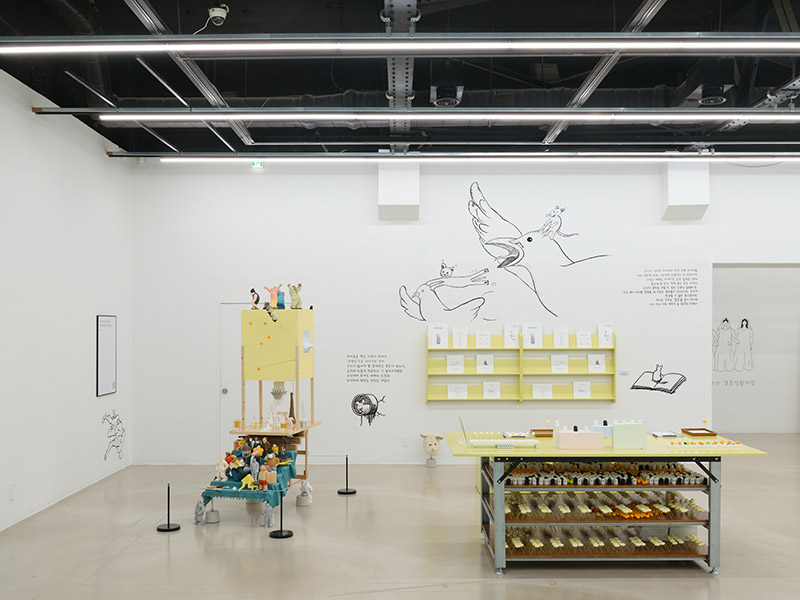
학회쥐, 〈쥐에 대한 상상〉, 2026, 나무, 스티로폼, 혼합 재료, 194×61×142cm
학회쥐, 〈귤까마귀우유〉, 2026, 석고에 채색, 무발포 우레탄, 황동봉, 2.5×3×3cm, 4×3×6cm, 10×7×4cm
학회쥐, 〈도시의 작은 이들과 더불어 살아가는 슬기로운 방법〉, 2026, 그림책, 여러 판형
YPC, 〈서울에서 미술하기〉, 2026, 책, 21×14.8cm
옐로우 펜 클럽(Yellow Pen Club, 이하 YPC)은 권정현(총총), 이아름(루크), 유지원(김뺘뺘)이 미술비평을 공부하기 위해 2015년에 조직한 소규모 모임이다. 2016년부터 온라인에 미술 관련 글을 게재하였으며, 2022년부터는 오프라인 공간인 YPC SPACE를 운영하고 있다. 함께 전시를 보고, 이야기하고, 글을 써 온 활동을 바탕으로, 미술과 그 주변의 것에 대해 배우고 대화하며 관찰하고 만들고 제시하는 장이 되고자 한다.
구재회, 최보련, 최주원, 최희정으로 구성된 학회쥐는 2021년 창립 이후 비공개 모임을 이어오며 예술 창작의 주체와 조건에 관한 글을 쓰고 이를 온라인 공간에 게재한다. “예술에서의 일련의 글쓰기 및 지식 취하기 관례가 약탈적 학회의 특징을 두루 갖추고 있다”라는 발상에서 출발해 일종의 유사 학회를 지향하며 학회 정관과 조직도를 모방한다. 미술 현장에 대한 괴담이자 구전설화 같은 학회쥐의 글쓰기는 도시에 출몰하는 쥐처럼 틈새를 오가며 미술 현장과 그 조건을 드러낸다.
이번 전시에서 YPC와 학회쥐는 ‘글’이라는 공통의 매개를 두고 관객과 글을 교환하거나 읽고 쓸 수 있는 테이블을 마련한다. 〈귤까마귀우유〉는 테이블 위에 놓인 작은 귤, 까마귀 두상, 걸어 다니는 바나나우유 가운데 관객이 마음에 드는 것을 골라 그에 대한 글을 쓰고, 그 대가로 작품을 가져가는 작업이다.
〈쥐에 대한 상상〉은 가상의 이야기 ‘쥐가 되기 위한 방법’을 구상하는 과정에서 떠오른 이미지를 조각으로 구현한 작업으로, ‘쥐가 되고자 하는 태도’는 곧 예술가로 살아가는 것과 다르지 않다는 상상에서 비롯한 유머러스한 조각들로 이루어진다.〈도시의 작은 이들과 더불어 살아가는 슬기로운 방법〉은 학교와 가르침, 그리고 배움에 관한 짧은 이야기를 어린이 그림책 형식으로 옮긴 전집이다.「열두 가지 앎의 상태를 비밀리에 오가는 인식적 쥐」,「자기만의 쥐구멍」,「자기 주도 학습」,「보름달은 자정에 남중」등의 단편은 학교와 교육에 대한 우화이다.
〈서울에서 미술하기〉는 YPC가 소규모 비영리 전시 공간을 운영하며 겪은 소회를 다양한 형식의 글로 풀어낸 작업이다. 독립 공간으로서 정체성 유지하기, 콜렉티브로서 관계 지속하기, 제도를 이용하고 비판하며 활동하기 등 그간의 경험에 상상과 유머를 더한 이야기다.
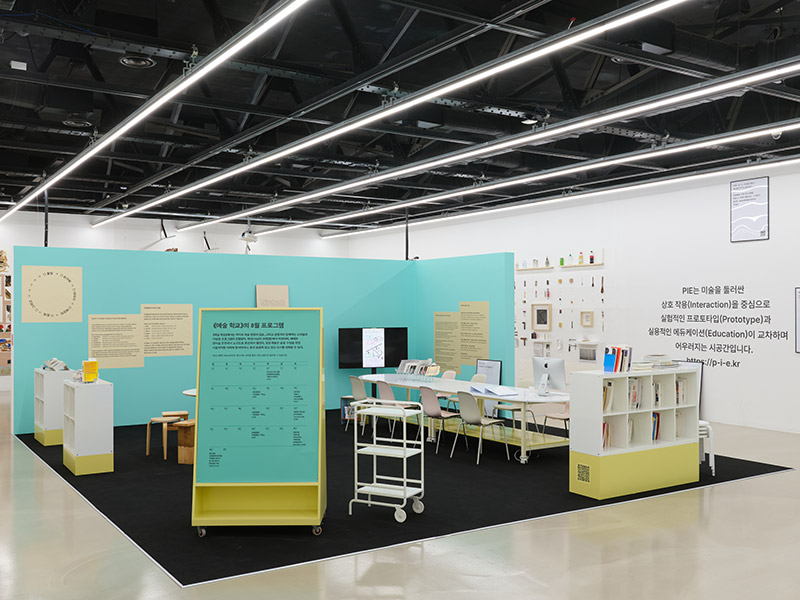
버드콜, 〈리빙룸〉, 2026, 읽기 스테이션에 책, 인쇄물, 오브제, 웹 사이트, 모니터, 키보드, 마우스, 가변 크기
버드콜은 예술과 디자인을 중심으로 자료와 도구를 제공하는 학습 공간이자 커뮤니티로, 이지수가 운영한다. 운영자 한 사람을 주축으로 움직이지만, 다양한 사람들을 초대해 워크숍을 기획하고 함께 학습한다. 도서관이자 놀이판의 기능을 가진 월드와이드웹의 환경을 운영에 참조해 개방성과 편집 가능성을 공간 운영의 방향으로 삼는다. 버드콜은 학습을 중심에 두는 환경을 스스로 설계하려는 필요에서 출발한, 일종의 자생적 학습 생태이다.
〈리빙룸〉은 버드콜과 서울리딩룸의 소장 자료를 비롯해, 이번 전시 참여자들의 추천 도서와 예술 및 교육을 주제로 한 서적으로 구성된 라이브러리이다. 이 라이브러리에서는 단행본뿐만 아니라 그 내용과 연계된 오브제, 사무용품, 액자, 에페메라 등 다양한 사물이 서로 관계망을 이룬다. 〈리빙룸〉의 도서는 주제나 장르, 저자 등 일반적인 분류 방식을 따르기보다는 임시적이고 장난스러운 동시에 문학적인 방식으로 배열된다. 관람객이자 독자는 우연히 집어 든 자료에서 다른 자료와의 관계를 발견할 수도 있다. 또한 버드콜이 만든 핸드메이드 웹사이트는 현장의 자료를 재분류하며 웹상에 배움의 경로와 좌표를 생성한다. 서울리딩룸은 버드콜과 협력해 배움에 관한 읽을 거리를 모아 인쇄물과 링크 묶음을 제공한다.
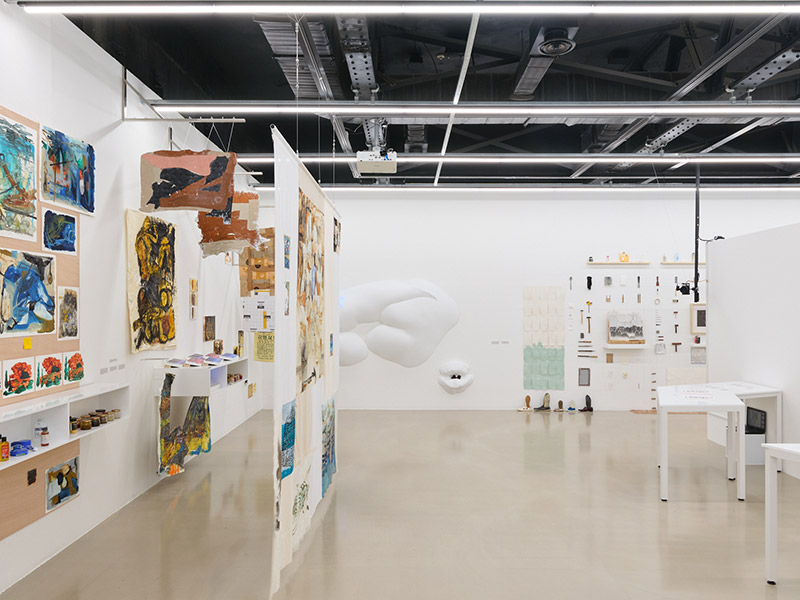
머터리얼 라이브러리, 〈머터리얼 라이브러리〉, 2026, 김륜아, 서제만, 정지원, 장소윤, 김희원, 백승환, 방재현의 실험물, 가변 크기
머터리얼 라이브러리는 2024년부터 3기를 운영하는 동안 15명의 창작자가 16개의 리서치를 발표하며 연구 결과를 웹 오픈소스로 공개해 오고 있다. 작업의 기초 단계에서 실험이 필요한 물질과 재료를 연구하는 공동체를 지향하며, 학교 밖에서의 현장 경험과 실험을 장려하고자 대학의 비(非)교과 과정으로 만들어졌다. 이번 전시는 김륜아, 서제만, 정지원, 장소윤, 김희원, 백승환, 방재현이 참여하고, 박관택, 윤소린이 이끈다.
이번 전시에서 머터리얼 라이브러리는 지난 3년간 진행해 온 재료 리서치 가운데 회화, 드로잉, 판화, 사진, 3D 스캐닝 총 다섯 개의 연구를 선보인다. 이들은 리서치 과정에서 도출된 다양한 실험물을 집적해 하나의 스튜디오처럼 보여준다. 일곱 명의 작가에게 재료 실험은 물감과 지지체 등 재료의 물성과 그 물성의 조합에 따른 결과를 기록하며 어떤 효과가 자신의 작업 행위에 적합한지 발견해 나가는 과정이었다. 동시에 이러한 실험의 과정은 각자의 작업 방법론을 구축해 가는 물질과의 협업이기도 했다.
김륜아, 서제만, 정지원은 유화 물감의 안료, 기름, 지지체를 연구하는 한편, 서로 지지체를 공유하며 그 변화 양상을 논의하는 협업을 진행했다. 장소윤은 종이 대신 석고를 지지체로 삼아 드로잉하고, 그 과정을 입체적 구조물로 확장해 보여준다. 김희원은 별도의 장비 없이 판화를 제작할 수 있는 무장비 판화술을 고안하고, 다양한 방법으로 판화를 찍을 수 있는 도구와 재질을 연구한다. 또한 머터리얼 라이브러리는 물질을 기술적 지지체로 확장해 해석하는 연구 과정을 포함한다. 백승환은 사진을 기반으로 사진과 영상 매체의 시간성을 탐구한다. 예측 가능한 이미지와 전시장에서 실시간으로 촬영되는 이미지를 교차해 “사진이 촉발하는 새로운 시간성”을 드러낸다. 방재현은 3D 프린팅 조각과 영상 매핑을 통해 신체를 다양한 지지체로 변환하며, 그 과정에서 발생한 물리적, 심리적 간극을 보여준다. 이외에도 머터리얼 라이브러리가 축적해 온 연구 데이터 아카이브도 함께 살펴볼 수 있다.
▣ 전시장 전경
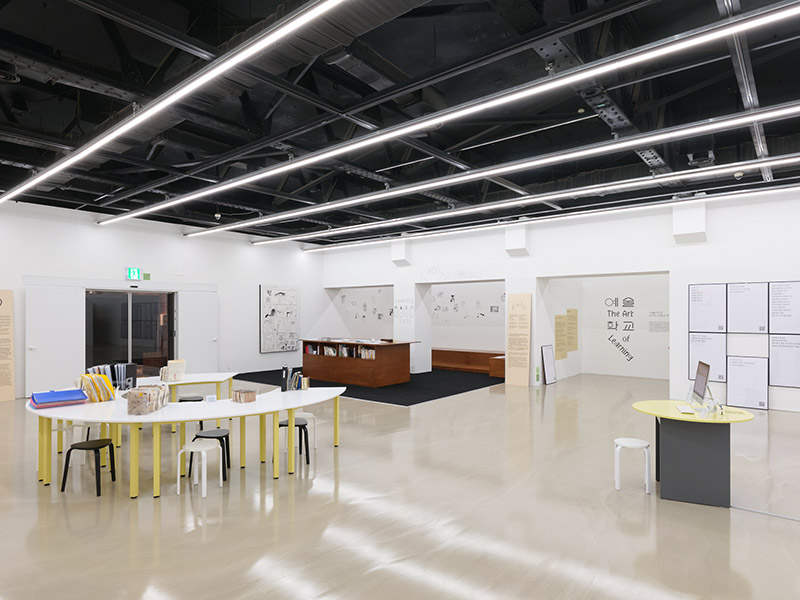
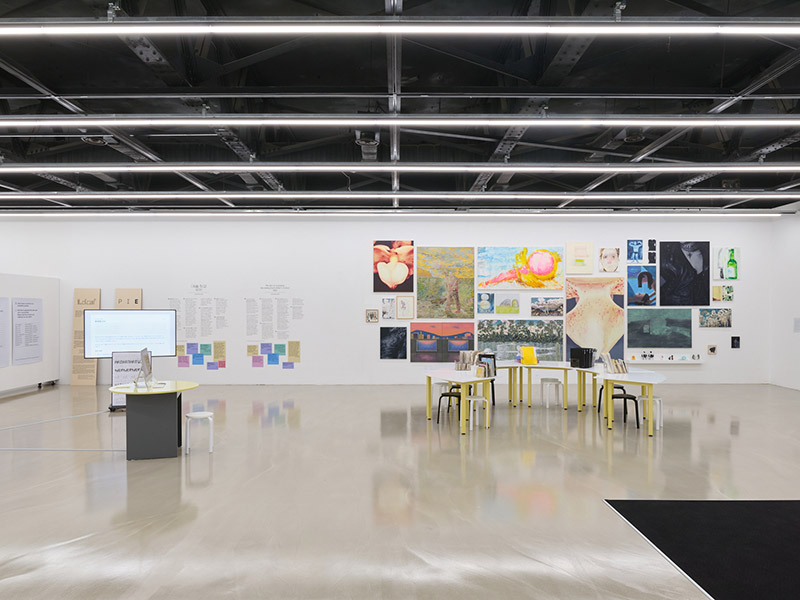
제1전시실 전경
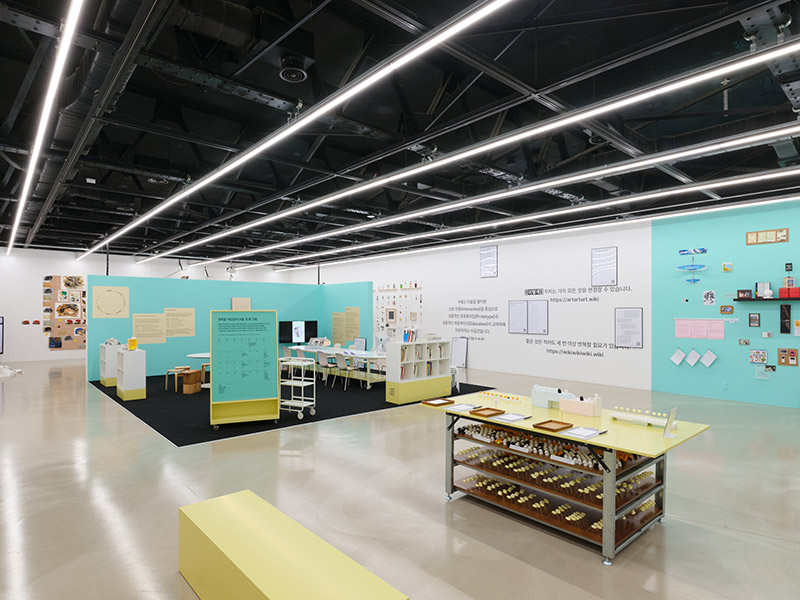
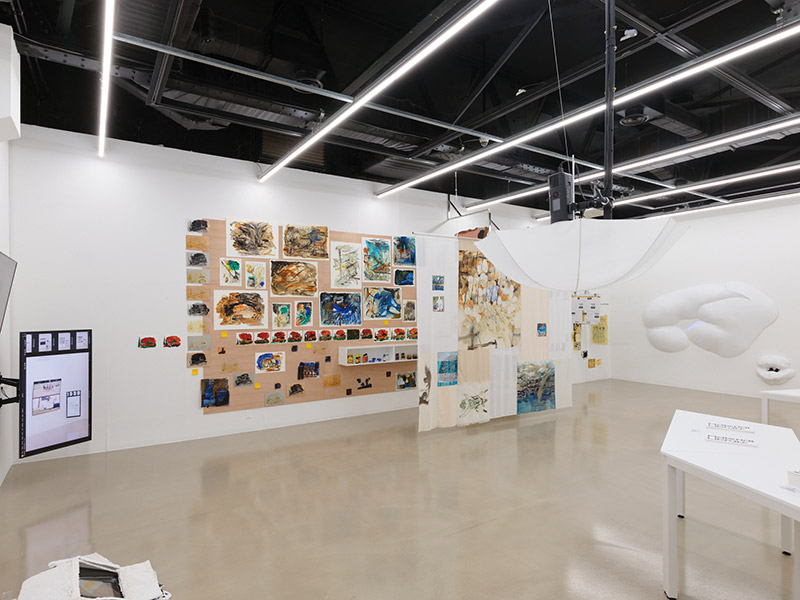
제2전시실 전경
▣ 프로그램 소개
2026 ARKO Art Center Thematic Exhibition The Art of Learning: Becoming Each Other’s School
▣ Overview
- Title : 2026 ARKO Art Center Thematic Exhibition The Art of Learning: Becoming Each Other’s School
- Artists : Material Library, Mockcamp, Birdcall, Kuroda, Curating School Seoul, Happy Class, PIE, YPC × Rat Journal
- Date : 2026.8.7.(Fri) - 9.27.(Sun)
- Opening Hours : Tue-Sun, 11:00–19:00 (extended hours on Wednesdays until 21:00)
- Venue : Gallery 1, 2, ARKO Art Center
- Free for Admission
- Hosted by Arts Council Korea
- Sponsored by MnJFoundation, Seojeon Cultural Foundation
▣ Introduction
Participants in the exhibition The Art of Learning: Becoming Each Other’s School❶ include artist-led groups, collectives, studios, art spaces, and schools that independently organize their curricula, gatherings, and workshops.❷ The exhibition examines the motivations and approaches of self-organizing individuals who pursue creative endeavors and are connected by common interests.❹ It also explores their modes of learning, including collaboration, knowledge sharing, and peer formation. Rather than functioning as a final product, the exhibition seeks to raise questions that lead to creative processes and collegial relationships. It aims to be a site where these processes unfold.❸ It features diverse programs, including small-group gatherings where artists, colleagues, and audiences can meet. These programs reveal successive phases of practice, experimentation, and research.❺ All these activities is created through the mediums of dialogue, shared laughter, ongoing encouragement, and mutual support exchanged among colleagues at the table.❻
The Art of Learning: Becoming Each Other’s School Wiki
artartart.wiki
- ❶ The word “school” in The Art of Learning: Becoming Each Other’s School departs from its conventional meaning as an institutional or formal site of education. It is redefined here to refer to the connections and relationships formed by artists and collectives who autonomously sustain their practices at the margins of the system.
- - Insa Art Space (2000–2025), operated by ARKO Art Center, supported emerging artists and served as an educational platform. This temporary school hosted by ARKO Art Center (hereafter referred to as “the School”) honors the role that Insa Art Space played—enabling creative processes rather than presenting finalized exhibitions—by seeking to serve as a studio, laboratory, and community lounge that fosters creative projects and knowledge production among artists.
- ❷ Eight groups, comprising forty-two individuals, are participating in the School at ARKO Art Center. They operate under various designations, such as artist led group, collective, studio, art space, and school, while organizing themselves as independent institutions and systems. They independently design workshops, lectures, and meetings and cultivate learning through knowledge sharing and collective study. Instead of speaking the language of exhibition, these activities give rise to networks of relationships: people and environments.
- ❸ Colleagues in the art world function as schools for one another. They share common interests and provide the support necessary to persist through creative struggles. While organizing the process of learning collectively, each participant assumes practical roles while contributing to and shaping these processes. New pathways to knowledge emerge through peer reviews and discussion.
- ❹ Self-organization can be understood as both a way of life and a strategic choice for creative practitioners working in an era of uncertainty. At a time when educational systems and state structures often fall short, it represents an effort to invent alternatives and create autonomous spaces. This phenomenon of self-reliance and independence is closely tied to how younger generations navigate neoliberal conditions by adapting to changes and managing risk. It also reflects a reality in which individuals are increasingly held accountable for systemic problems. The growing emphasis on self-reliance, despite younger artists’ negative prospects, can thus be read as symptomatic of the challenges they face.
- ❺ ARKO Art Center temporarily operates the School, a composite entity. This provisional framework fosters processes of practice, failure, and learning. Simultaneously, it reveals the structural conditions of the art world, the interconnections among practitioners, and the organization of the ecosystem both within and beyond institutional systems.
- ❻ What, then, should this School be? It should be emotional bonds built upon shared interests; an expansion of knowledge through openness and sharing; and affectionate observations among teachers, colleagues, and senior and junior practitioners in the field. It should also be···
The process of building friendship during creative struggles by supporting one another, resolving intermittent conflicts thoughtfully, and ultimately building solidarity.
ㅡ Happy Class(Kyoungho Koh)
Imagining a world in one’s own way, cultivating curiosity about the world others envision, and sharing and immersing oneself in one another’s visions.
ㅡ Kuroda
Keeping one another company in a state of becoming and bringing into view images not yet fully visible.
ㅡ Mockcamp(Juyeon Park)
A place for gathering or a gathering itself where individuals share their sense of self-worth, their inspirations for creative practice, and build solidarity with one another.
ㅡ Material Library
We part ways while our translations of one another remain unfinished; in doing so, the number of new versions continues to grow.
ㅡ Curating School Seoul · Seoul Reading Room(Jaeyong Park)
This School is: a pub with the sunset seeping in, a childhood marked by incomprehensible violence, the fluorescent light illuminating an art classroom, mala xiang guo without meat ordered for a vegan friend, a financial crisis and a strike, numerous possibilities of becoming anything and thus becoming nothing, things we knew without being taught, receiving all these things without giving anything in return, and not saying thanks.
ㅡ Rat Journal
Despite all this, why do we still seek to connect with one another?
ㅡ PIE
*For additional responses, please visit artartart.wiki
▣ Selected Works
PIE, PIE Loves You, Anyway. You Love PIE, Anyway., 2026, inkjet prints, frames, 91×61cm (30)
Founded in 2014, PIE is a collective and a space run by Park Hyunjung, Don Sunpil, Min Guhong, and Son Jooyoung. Grounded in the diverse methodologies and experimental practices of artists, PIE oers practical curricula for artists. Instead of focusing on self-development programs, the space aims to support participants in developing their own questions as well as training their thinking practices.
For this exhibition, PIE proposes an approach to learning through language and documentation. PIE Loves You, Anyway. You Love PIE, Anyway. is a collection of thirty posters containing sentences about learning written by PIE tutors. It functions as a kind of manifesto that confesses a love for art through words and writing, which are understood as foundational media for learning. Min Guhong, an organizer at PIE, created artartart.wiki, a digital platform for sharing, using the text file-based PHP wiki engine wikiwikiwiki.wiki. Without complex setups, users can compose texts and generate hyperlinks. Following these links reveals how the documents are linked to one another. artartart.wiki connects the exhibition, artists, and viewers in real time through documents, expanding their relationships while functioning as a public sphere that continually produces narratives about how art comes into being. This project will continue after the exhibition closes. In Search of Lost Sentences is a text-based installation that tracks and collects sentences dispersed throughout the space using QR codes and a web application. The QR codes enable the distribution and publication of the text, linking the acts of walking, searching, saving, and losing. Viewers can discover QR codes hidden within the gallery space and collect short sentences about the School in operation, thereby engaging in active learning.
PIE is both a participant in the exhibition and a platform for human networks, connecting the exhibiting artists as hyperlinks do. For example, it assumed the role of “mate” for Mockcamp, supporting the sustainability of art collectives and the operation of independent spaces through the pre-exhibition program, Learning with Peers. PIE provided support for Mockcamp while it recruited participants for and developed an “exhibition installation practice,” which is presented in the exhibition. Another contribution was an invitation to Ginkgo Fruit Social Club, a group of young visual artists formed around a shared interest in subcultures. The group was given a space by Studio PIE in 2025 to conduct free experimentation. Through such efforts, PIE functions as a (non-institutional) educational platform. Its endeavors are rooted in researching conditions and environments that enable artists to remain independent while fostering meaningful relationships.
Mockcamp, Mockcamp, 2026, storage space and partition by Nayœng Kim, Jayeon Kim, Juyeon Park, Yeojin Yun, Sang-hee Lee, leo je-eon lee, Hyunryeong Chun, and Jieum Choi, live streaming, individual pieces and collaborative practice, 1200×685×390cm. Installation view of Group installation ①.
The story of Mockcamp’s origin reveals the nature of the group. When Juyeon Park could not recover her deposit on a private home in Hyehwa-dong, she transformed it into an art space for everyone. After learning from construction workers how to install partitions and tile floors, she renovated the space herself, creating an art space with partitions for exhibitions; Mockcampsite Hyehwa opened its doors in 2025. The goal was to enable artists to experiment with different installation methods and provide a space for those without studio access. Through a first-come, first-served system, interested individuals can rent the space for free without any credential review. The only condition is that participants must organize a team of three or more and together practice installation for a week. They then set up and document an installation each day. Mockcamp strives to be open-source and publicly accessible. Participants become active facilitators, even if only for a week. The goal of Mockcamp is to foster collegial relationships.
The four artists—Nayœng Kim, Jayeon Kim, Juyeon Park, and Jieum Choi—who met at Mockcampsite Hyehwa have formed a group with Yeojin Yun, Sang-hee Lee, leo je-eon lee, and Hyunryeong Chun, who were recruited through an open call. Together, they will
operate their own camps across ARKO Art Center and Mockcampsite Hyehwa.
These eight Mockcamp members will engage in installation practices by changing the show every four days during the exhibition period. Overturning the notion of a completed exhibition, they will repeat the process of installing, exhibiting, and deinstalling in collaboration with their colleagues, presenting the ongoing transformation of their work to viewers. Collectively, they will build structures, support each other in installing the shows, and allow their peers to intervene in the process. These activities at Mockcampsite Hyehwa will be streamed live. The two-month-long group practices and rehearsals will involve failures and modifications, which constitute a form of experimentation. The time spent on this project may lead to subsequent projects.
Happy Class, Paintings, 2014-2026, mixed media, dimensions variable (26)
Happy Class, Sculptures, 2025-2026, mixed media, dimensions variable (8)
Happy Class, Drawings, 2023-2026, mixed media, dimensions variable (76)
Jiwon Kim, In Front of Similar Wall, 2002, gouache, pen and object on paper, 25.5×25cm
Jiwon Kim, A Desk for Designing a Brighter Future, 2001, gouache and pen on paper, 21×12.5cm
Jiwon Kim, Geunyang Pul and Jazz, 2026, print on paper, 29.7×21cm
The group Happy Class was formed in 2023 by six painters with a shared interest in drawing: Kyoungho Koh, Seunggyu Kim, Miyeon Ra, Jihyun Im, Sungju Ham, and Yerang Hwang. The members began with the determination to follow Bahc Yiso’s drawing curriculum as a means of training themselves. Happy Class meets every month, with each person sharing their drawing book, posing questions, and responding to them. The gatherings are not for evaluation but allow the members to be each other’s audience and serve as motivation to pursue their own methodologies.
Drawings documents the daily work performed by Happy Class. They are drawings of perceptions and thoughts encountered each day. Viewers can flip through the pages of the sketchbooks on display, which reveal drafts that precede final images, drawings as ideas, and drawing as a comprehensive medium, thereby revealing the pleasure of the creative process.
The work that fills the wall is Paintings, composed of works selected by the members of Happy Class based on impressions and responses shared among themselves. The act of selecting works by colleagues allows the members to look at their own work from another perspective: that of their colleagues. This gesture resonates with many aspects of creative practice, such as returning to one’s studio and persisting in an artistic practice supported by one’s peers.
Paintings invited artist Jiwon Kim to participate to expand the idea of colleagues. Kim is a teacher and someone with experience in the field; He has also been a long-time observer and colleague of the members of Happy Class. For this exhibition, the group held a meeting with Kim. He shared various stories: His struggles as an artist, routines that are helpful for his practice, drawing exercises, teaching methodologies, and drawing exchanges with his artist colleague. Happy Class’s work is accompanied by Kim’s pieces in the exhibition: A Desk for Designing a Brighter Future (2001), inspired by an image of an installation by Bahc Yiso found in an art magazine (the title is the same as that of Bahc’s piece); In Front of Similar Wall (2002), a portrait of artists belonging to different eras; and Geunyang Pul and Jazz (2026), a text describing drawing exchanges with Bahc, as well as related anecdotes. Kim and his memories of Bahc cross paths with Happy Class, forming a loose network of relationships within this drawing community that the group has enriched.
Kuroda, Kuroda’s Love Letter, 2026, silkscreen on paper, 200×150cm
Installation view of Kuroda
In the fall of 2022, Rim Park, Yuna Lee, and Yoonan began a manhwa [Korean term for comics and print cartoons] collective, Kuroda, at a cafe in Itaewon; they set out to observe and produce a wide range of works while sharing critical discussions and creative practices both within and beyond the community. Since becoming active in 2023, the members—an artist, a writer, and a mangaka—have explored the medium of manhwa, a shared interest, through regular gatherings, independent publications, and exhibitions.
Kuroda has led manhwa workshops where participants collectively decide on topics and genres and produce drawings in their distinctive styles. It also organizes gatherings that include the viewing of manhwas and the documenting of discussions. Other activities include drawing workshops, inspired by the culture of secondary creation—popular in fan communities—in which characters and settings are appropriated from existing works. For a pre-workshop, Kuroda invited friends working in the visual arts, moving images, and music to create a short manhwa. The collective invented an imaginary character named ‘Guroda,’ and their friends contributed to shaping its personality and role within a fictional world. A collection of short manhwa pieces created throughout this process will be published as an anthology titled So, I…. Within this collective process,one can observe forms of emotional bonding specific to fan cultures that are grounded in the sharing of subcultural interests. This raises a question: Is there an equivalent form of such a community within the art world, that is, communities or cultures grounded in this kind of bond and these affinities?
This question leads to Kuroda’s Love Letter, which depicts how art communities approach art and their practice, as well as the collective’s unconditional love for art. This piece is a manhwa centered on self-organization.
Meanwhile, To You, comprising the workshop results, blank sheets of paper, and various
manhwa books, is a participatory piece in which viewers can create their own love letters. Just as manhwa finds its way into a reader’s heart, the piece invites viewers to articulate and express their affection toward someone they hold dear.
Curating School Seoul, Learning Inside, Outside, Upside Down, 2026, objects collected from participants, printed text on the wall, dimensions variable
Curating School Seoul oers a space for those who want to create to gather and learn. It is an experiment in schooling through curation, exploring the points of encounter between contemporary creative work and education. After operating a pilot semester in 2013, Curating School Seoul returned in 2023. Currently, it is run by Sejin Park, Jaeyong Park, and Eunsong Lee. Ten core members are selected each semester based on what they wish to create, rather than their art-related backgrounds or education credentials. The program offers workshops, seminars, public lectures, site visits, and practical training related to each semester’s keyword: curating, school, or Seoul.
Learning Inside, Outside, Upside Down traces how each participant in The Art of Learning came to be a creative practitioner. Curating School Seoul conducted two interviews with each person about their learning process and how the group that person belonged to began. The questions were seemingly trivial yet personal: When did they first feel the desire to create? What had they learned during and outside formal education and from whom? Which places, objects, artworks, and events inspired their learning endeavors? How did they meet one another, and what were their first impressions? From these interviews with self-organizing artists, Curating School Seoul compiled words, objects, books, and images that inspired them, offering a glimpse into myriad moments of learning that shaped their practice. Diagrams that are also collages, created from this material, show how practitioners’ learning, life, and care are intimately connected.
Rat Journal, Imagining a Rat, 2026, wood, styrofoam, mixed media, 194×61×142cm
Rat Journal, Tangerine Crow Milk, 2026, painted plaster, non-foaming polyurethane, brass rods, 2.5×3×3cm, 4×3×6cm, 10×7×4cm
Rat Journal, A Wise Way of Living Together with the Little Ones of the City, 2026, picture books, dimensions variable
YPC, Making Art in Seoul, 2026, book, 21×14.8cm
Yellow Pen Club (YPC) was formed in 2015 by Junghyun Kwon (Chong Chong), Areum
Lee (Looc), and Jiwon Yu (Bbyabbya Kim) as a study group focused on art criticism. It began publishing art-related texts online in 2016. Since 2022, it has operated a physical space known as YPC SPACE. Motivated by its collective endeavors of exhibition viewing, discussion, and writing, YPC positions itself as a site of learning, conversation, observing, and creating, and presenting art and its context.
Since its foundation in 2021, Rat Journal (Koo Jaehoi, Choi Boryeon, Choi Joowon, and Choi Heejung) has held private meetings while producing and publishing online texts on art and the conditions of art making. Originating from the idea that “the conventional modes of writing and knowledge production in the art world are in line with many aspects of predatory journals,” Rat Journal aspires to be a “pseudo-society,” and it imitates the articles of incorporation and organization chart of a journal. Its writings—urban legends or folklore about the art world—resemble rats haunting the city, exposing underlying conditions and realities of the art world.
In this exhibition, YPC and Rat Journal have prepared a table for audience participation,
where texts can be read, written, or exchanged with objects. Tangerine Crow Milk is a work in which viewers write about one of the following sculptures on the table—a tangerine, a crow’s head, or a walking banana-flavored milk—and leave their text in exchange for the chosen object.
Imagining a Rat is a sculptural piece originating from the images evoked during the conception of a story titled “How to Be a Rat.” This humorous work is based on the idea that trying to become a rat is not much different from living an artist’s life. A Wise Way of Living Together with the Little Ones of the City is a collection of short stories in a children’s book format about schools, lessons, and learning. The collection also includes An Epistemic Rat Hopping Undetected between Twelve States of Knowing, A Rat Hole of One’s Own, Self-Directed Learning, The Full Moon Culminates at Midnight, in which readers encounter fables about education and school.
Making Art in Seoul is a text-based work in various formats that reflect on YPC’s experiences operating a small scale nonprofit art space. It tells stories—enriched with imagination and humor—drawn from their experiences, such as maintaining their identity as an independent space, sustaining relationships as a collective, and engaging with the art world while both utilizing and critiquing the institutional framework.
Birdcall, Living Room, 2026, books at a reading station, printed materials, objects, website, monitor, keyboard, computer mouse, dimensions variable
Run by Jisu Lee, Birdcall is a space for study and a community that provides materials and tools related to art and design. Although managed by a single individual, Birdcall invites diverse individuals to organize workshops and study together. Functioning as both a library and a playground, Birdcall aims to maintain accessibility and ease of editing, drawing on the ethos of the early World Wide Web. It constitutes a self-sustaining educational ecosystem, prompted by the need to design a study-oriented environment.
Living Room is a library featuring the collections of Birdcall and Seoul Reading Room, as well as books recommended by the exhibition artists, alongside books about art and education. Networks are formed among diverse objects, including paperbacks accompanied by objects related to their topics, office supplies, frames, and ephemera* in the library. The classification of books here does not follow conventional systems (by subject, genre, or author); rather, they are organized spontaneously, playfully, and poetically. Audiences, as readers, may discover unexpected connections between the material in hand and other items in the space. The self-editable website by Birdcall reclassifies the materials presented in the exhibition space, generating alternative pathways and sign systems for learning. In collaboration with Birdcall, Seoul Reading Room gathers readings on learning, offering them as printed matter and a bundle of links.
*temporary publications and documents
Material Library, Material Library, 2026, experimental materials by Luna Kim, Jeman Seo, Jiwon Jeong, Soyoon Chang, Heewon Kim, Seunghwan Baek, and Jaehyun Bang, dimensions variable
Material Library launched its third term in 2024. Since then, fifteen artists have conducted sixteen research projects, the results of which are uploaded to the web as open-source information. This community aims to support material research and experimentation in early stages of an art project. As a means of encouraging practical experience and exploration outside academia, the course was designed as an extracurricular activity at a college. Participants in this exhibition are Luna Kim, Jeman Seo, Jiwon Jeong, Soyoon Chang, Heewon Kim, Seunghwan Baek, and Jaehyun Bang. The group is led by Kwantaeck Park and Solin Yoon.
For the exhibition, Material Library presents five material research projects—painting,drawing, printmaking, photography, and 3D scanning—selected from three years of work by the group. They compile various objects derived from their research and give the exhibition space the appearance of a studio. For the seven participating artists, medium experimentation has been a process of documenting materialities and their combinations to ultimately find what suits their own practice. It is, in a way, a collaboration between the artist and the medium during the process of establishing methodologies.
Together, Luna Kim, Jeman Seo, and Jiwon Jeong studied pigment, binder, and surface while sharing different test results for the surfaces they tried. Soyoon Chang creates drawings on plaster and presents her development in a sculptural form. Heewon Kim has designed a non equipment printmaking technique and continues to experiment with different methods of printing tools and texture making. Material Library also includes research that interprets the medium as a technical surface. Seunghwan Baek explores the temporality of photography and the moving image through his photographs. Shuffling between predictable images and live images captured from the gallery, he creates “a new temporality triggered by photography.” Jaehyun Bang transforms the body into various surfaces through 3D printed sculpture and projection mapping, revealing the physical and psychological gaps between the processes. The research data is archived for viewing in the exhibition space.
▣ Installation View
Gallery 1
Gallery 2